Health care reform law's auto-enrollment rule repealed
Bipartisanship may not extend to other revamp efforts Reprints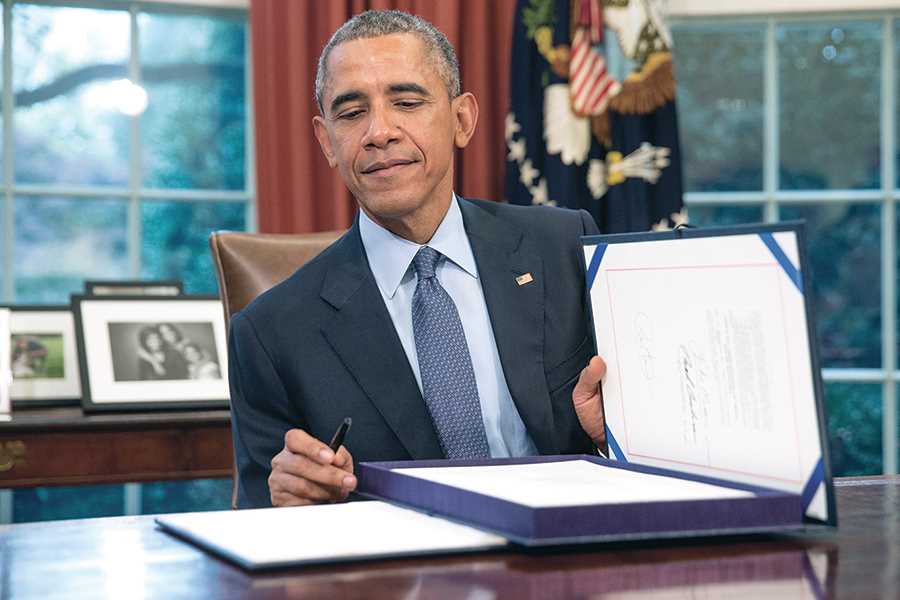
Repealing the health care reform law's automatic enrollment requirement will help employers, but that move does not open the door to repeal of other law provisions employers are urging legislators to junk.
In rare speedy and bipartisan action last month, Congress passed and President Barack Obama signed budget legislation to prevent a government shutdown and default on its obligations.
Included in H.R. 1314 is a provision that repeals a yet-to-be-implemented requirement under the Patient Protection and Affordable Care Act that employers with at least 200 full-time employees automatically enroll those workers who do not respond when asked to select a group health plan offered by the employer.
Employers long championed repealing automatic enrollment, for which regulators had yet to develop rules and, as a result, had not yet taken effect.
Employers complained about several issues, including the lack of guidance on how much discretion they had in choosing a plan in which to automatically enroll employees.
“How do you determine which plan to put an employee in? Could it be the most expensive plan? The least expensive plan? The most popular plan?” asked Steve Wojcik, vice president of public policy at the National Business Group on Health in Washington.
One of biggest problems, experts say, was how employers would handle cases in which they automatically enrolled employees and, after employees complained, found out they were covered by their spouse's employer.
“The ability to get out of a plan was not straightforward,” said Michael Thompson, a principal at PricewaterhouseCoopers L.L.P. in New York.
“No one knew how disenrollment would work,” said Ann Marie Breheny, a senior legislative adviser at Towers Watson & Co. in Arlington, Virginia.
The driving force behind the bipartisan move, experts say, was the $8 billion in additional revenue, as estimated by the Congressional Budget Office, that would be generated by repealing auto enrollment. Fewer people in employer plans reduce employers' costs, thus increasing employers' taxable income.
“The repeal of the automatic enrollment requirement was an easy bipartisan decision to make, since it raised revenue and the requirement was not ready to be implemented,” said Annette Guarisco Fildes, president and CEO of the ERISA Industry Committee in Washington.
In contrast, however, repealing the 40% excise tax on high-cost health plans set to take effect in 2018 would cost the government $87 billion in revenue between 2018 and 2025, the CBO has estimated.
“This was largely a revenue-driven proposal,” said James Klein, president of the American Benefits Council in Washington, referring to the revenue gains racked up by repeal of enrollment. “The dynamics of other ACA provisions” whose repeal would not affect federal revenues is very different, Mr. Klein added.
Repealing automatic enrollment “doesn't very much change the outlook for repealing of other ACA provisions,” said Geoff Manville, a principal at Mercer L.L.C. in Washington.
In addition, congressional Democrats who oppose repealing the excise tax because it would reduce revenue to help fund premium subsidies to lower-income individuals buying coverage in public health insurance exchanges, have been joined by conservative Senate Republicans Ted Cruz, of Texas; Mike Lee, of Utah; and Marco Rubio of Florida, who want the entire law — not just individual provisions — scrapped.
For some congressional Republicans, “it is full repeal or nothing,” Towers Watson's Ms. Breheny said.
Aside from eliminating the health care reform law's automatic enrollment requirement, the budget law will sharply increase insurance premiums employers with defined benefit plans pay the Pension Benefit Guaranty Corp.
Those increases, which will require employers to fork over more than $4 billion in additional PBGC premiums through 2025, include:
• Boosting the so-called flat-rate premium, which is paid by all plan sponsors. The current $57-per-plan-participant rate, which is scheduled under a 2013 law to rise to $64 in 2016, will jump to $69 per plan participant in 2017, $74 in 2018 and $80 in 2019.
• Raising the so-called variable rate premium, which is paid by employers with underfunded plans. The budget law will increase that premium to $33 per $1,000 of plan underfunding in 2017, $37 in 2018 and $41 in 2019. That compares with $24 this year and $30 next year under existing law.
• Move up — just in 2025 — the Oct. 15 deadline for PBGC premium payments to Sept. 15. That change, benefits experts say, is budget gimmickry to include more PBGC premium income in the 10-year budget impact measuring period.
